Trust
Who decides what your AI says about your business?
AI already talks about your business, from the outside, from whatever it found. The question is not whether to allow that. It is whether anything out there speaks with your authority, under your control.
Jakov Manojlovski, founder of Predvora · August 30, 2026 · 5 min read
Somewhere today, someone asked an AI assistant about a business like yours. Maybe about yours. What it costs, whether you are any good, whether you handle their problem. The assistant answered in a confident paragraph assembled from whatever it had: your site as it looked at some point, a directory listing, a three-year-old review, the internet's general impression of your industry.
Nobody at the business approved that paragraph. Nobody saw it. There is no transcript to check and no edit button to press. That is the state of things now: your business is already being spoken about by machines, fluently and constantly, and the speaking happens entirely outside your reach.
Speech about you, without you
We wrote in the manifesto that AI systems increasingly answer questions about businesses from whatever they can find, and that the one surface a business fully controls is its own website. That argument deserves a sharper edge here. Outside AI does not misrepresent you out of malice. It paraphrases you out of indifference, because paraphrase is all it can do. It was not given your facts. It found some.
You cannot govern that speech. You can only outcompete it, by making sure the best, most current, most authorized answers about your business exist somewhere a machine and a human can both draw on: the place where you are the author.
Speech as you, without authority
There is a worse failure mode than being paraphrased from the outside, and a Canadian tribunal put a price on it. In 2024, Air Canada's website chatbot told a passenger he could book a full-price ticket and claim the bereavement discount afterwards. The airline's actual policy said the opposite. When the passenger claimed, the airline refused, and when he took the dispute to British Columbia's Civil Resolution Tribunal, Air Canada argued that the chatbot was, in the tribunal's words, "a separate legal entity that is responsible for its own actions."
The tribunal rejected that argument, found the airline liable for negligent misrepresentation, and ordered it to pay. The chatbot was not a separate anything. It was Air Canada's website talking, and what the website says, the business has said.
That is the legal system catching up to something we argued in knowing when not to answer: representation is delegated speech, and delegation without limits is not representation at all, it is a stranger talking in your name. The tribunal's version is blunter. There is no stranger. There is only you.
The wrong conclusion is "no AI, then"
Faced with that ruling, plenty of businesses drew the obvious conclusion: keep AI away from the website entirely. It is an understandable instinct and we have defended the caution behind it before. But look at what it actually buys you. The outside speech does not stop. The assistants keep paraphrasing, the confident paragraphs keep being assembled from found scraps, and your silence just removes the one voice that could have carried your authority. Opting out of AI does not opt you out of being spoken about. It only opts you out of the conversation about what gets said.
The real question was never AI or no AI. It is the question in the title, and it has an answer with an org chart in it: who decides?
Governance, concretely
For a representative on your own website, deciding is not a metaphor. It is a set of controls the business holds.
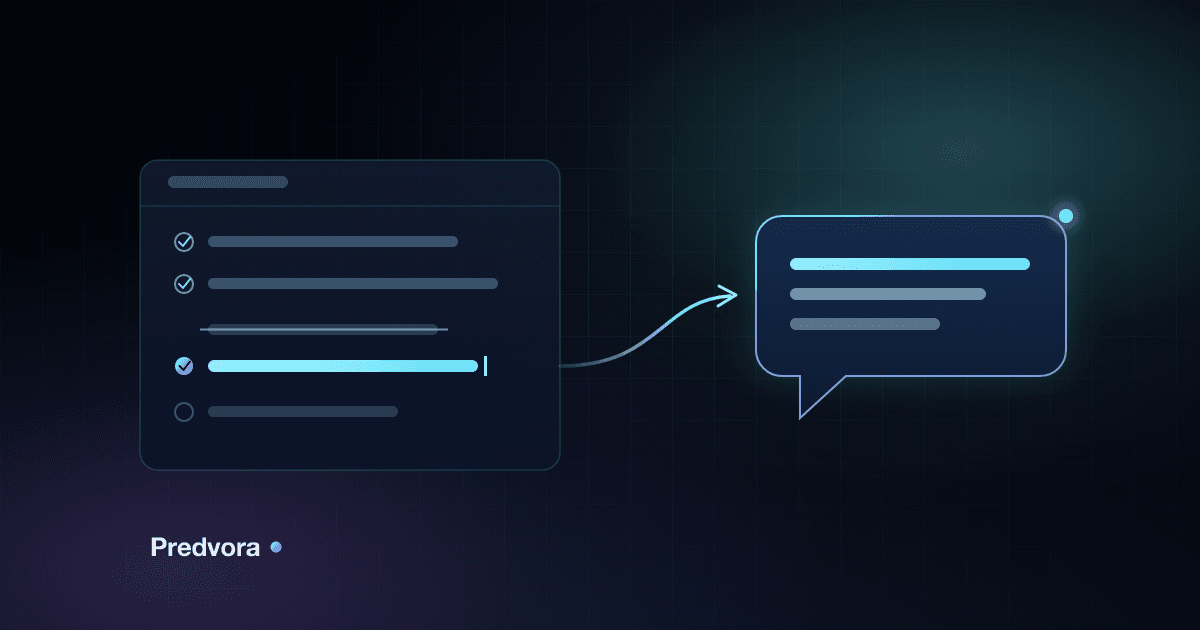
The representative speaks from a knowledge base the business owns. What it learned from your website sits there as reviewable facts, not as a sealed model: the business reads them, corrects them, and removes them. What the business edits is what the representative treats as true; your correction outranks what the crawl guessed. Knowledge the website never states gets added deliberately, as facts entered by hand or documents uploaded for the representative to answer from. And when the website changes, the knowledge is refreshed from it on the business's say-so, not behind its back.
Boundaries work the same way. The representative's standing rules never change hands: it does not invent prices, policies, or availability, and when it does not know, it says so and offers a person. We argued in the refusal piece that this is the job description; the point here is who writes the rest of it. What it should decline, and where it hands off, is written into the job it is given, not discovered by the model along the way.
We watched what this looks like in practice in the 30-questions experiment: an untouched representative refused thirteen questions because the firm's website was silent on them, honestly, every time. Under governance, that list of refusals reads differently. Each one is a decision waiting for its owner: a consultation price the firm can state in one edited fact, a response-time promise it can choose to make, a boundary it can choose to keep. The gaps get closed deliberately, in the firm's own words, or left closed on purpose. Either way, someone decided, and that someone runs the business.
The factual side of all this, how the underlying data is handled and retained, is a different kind of claim, and it lives where it belongs, on our security and privacy page.
The boring answer is the right one
"Who decides what your AI says about your business?" is the kind of question that sounds rhetorical until a tribunal answers it for you. It deserves the most boring answer available: you do. Written down, reviewable, edited in your own words, with the refusals you chose and the facts you signed off on.
Outside your website, machines will keep speaking about your business from whatever they find. On it, for the first time, you get to decide exactly what gets said, and prove it. Your website explains. It should represent. And what it says when it represents you should be nobody's decision but yours.
Written by Jakov Manojlovski
Founder of Predvora