Perspective
Your website explains. It should represent.
The business website was built for a patient reader, and that reader is disappearing. The case for the website's next job: representing the business, not just explaining it.
Jakov Manojlovski, founder of Predvora · August 29, 2026 · 5 min read
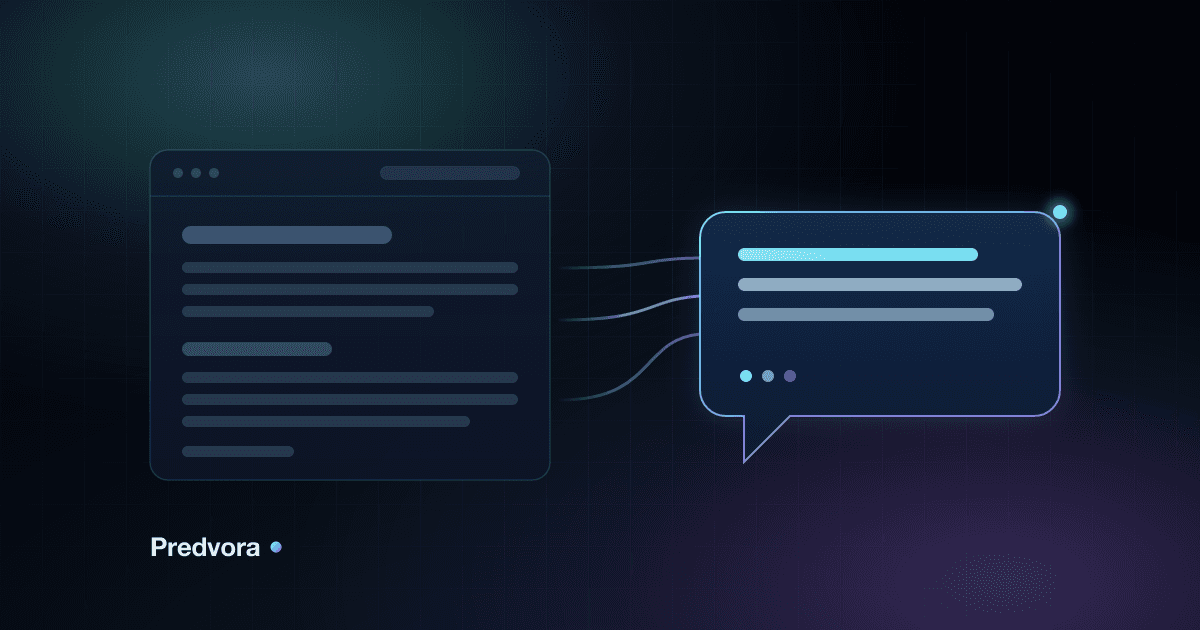
Every business website runs on a deal so old that nobody remembers agreeing to it. The business publishes: here is what we do, here is what it costs, here is the form. The visitor reads, compares, assembles an answer out of pages, and decides. The entire shape of the web assumes that second half of the deal. It assumes a patient reader.
The patient reader is disappearing
Not because people got lazy. Because software taught them a better interface: asking. People ask their phone, their search bar, and increasingly an AI assistant, and they get an answer in a sentence, not a list of places where an answer might be. Anyone who has experienced that does not go back to clicking through a sitemap with enthusiasm.
You can find the shift in your own behavior. Think of the last time you opened a restaurant's website to learn whether they could seat eight people on a Saturday. You did not want the About page. You did not want the photo gallery. You wanted someone to say yes or no.
On most business websites, a visitor with a question has two options: dig or leave. Digging loses to leaving more often than any business would like, and the loss is invisible. No error is logged when someone closes a tab.
Explaining is not representing
Walk into a good shop and something happens that no webpage has ever done. A person notices you. They ask what brought you in. They listen to your actual question, the one with your circumstances tangled into it, and they answer it directly. If they do not know, they say so and fetch someone who does.
That person is not explaining the business. They are representing it. The difference is the whole point: a brochure explains, a person represents, and for three decades the web has only known how to ship the brochure.
The website has always known the answer. It has never had a way to say it.
Here is the strange part: almost everything a representative needs is already on the site. The services, the prices, the process, the boundaries, even the tone of the business. What was missing was never information. It was behavior: the ability to attend to one specific visitor and answer them, in their words, from your knowledge. That behavior is the thing AI finally makes possible.
What representing actually means
A representative is defined by how it behaves, not by the box it lives in:
- It answers the question that was asked, not the page that was written. The visitor's phrasing leads; your knowledge follows.
- It speaks only from what the business actually says about itself. Its answers can be traced back to your own content, not to the internet's general opinion of your industry.
- It behaves like staff, not like a search box. It greets, it asks the clarifying question, and it points at the next step.
- It knows what it is for. An interested visitor should leave with an answer and a way forward: an appointment, an offer, a human's attention.
This is not the pop-up chatbot of the last decade, a decision tree wearing a support avatar. That gadget answered the questions the business predicted. Representation starts from the business's real knowledge and ends in a real outcome, and it is a different job entirely.
The most important sentence is "I don't know"
A representative that invents answers does not represent a business. It misrepresents it. A confident wrong answer about your prices or your policies is worse than silence, because it spends trust you never authorized it to spend.
So the boundary is part of the job description, not a disclaimer on it: answer from the business's actual knowledge, and when the knowledge is not there, say so plainly and bring a human into the conversation. Declining to guess is not a failure state. It is the behavior you would demand from anyone else who speaks for you. How we draw those boundaries, and how the data involved is treated, is written down on our security and privacy page.
The website is still the center
None of this replaces the website. The opposite: it finally justifies it.
Your website is the one place on the internet where your business speaks entirely for itself. No platform's ranking decides what gets seen, no marketplace's template flattens you into a category, no assistant's summary paraphrases you from the outside. And the outside is increasingly where the answering happens: AI systems now answer questions about businesses from whatever they can find. The one move a business fully controls is making its own website the place where the best answer exists, straight from the source.
The pages keep doing what pages are good at: depth, proof, detail, the record. The representative does the one thing pages cannot do: respond.
The next default
The explaining website took thirty years to become the default, and it earned that by being obviously better than no website at all. The representing website will feel obvious faster. The first time a visitor asks a real question on one site and gets a real answer, every silent site after it feels understaffed.
That is the change we believe is coming to business websites, and the one we are building for. Not a redesign. A new job.
Your website explains. It should represent.
Written by Jakov Manojlovski
Founder of Predvora